
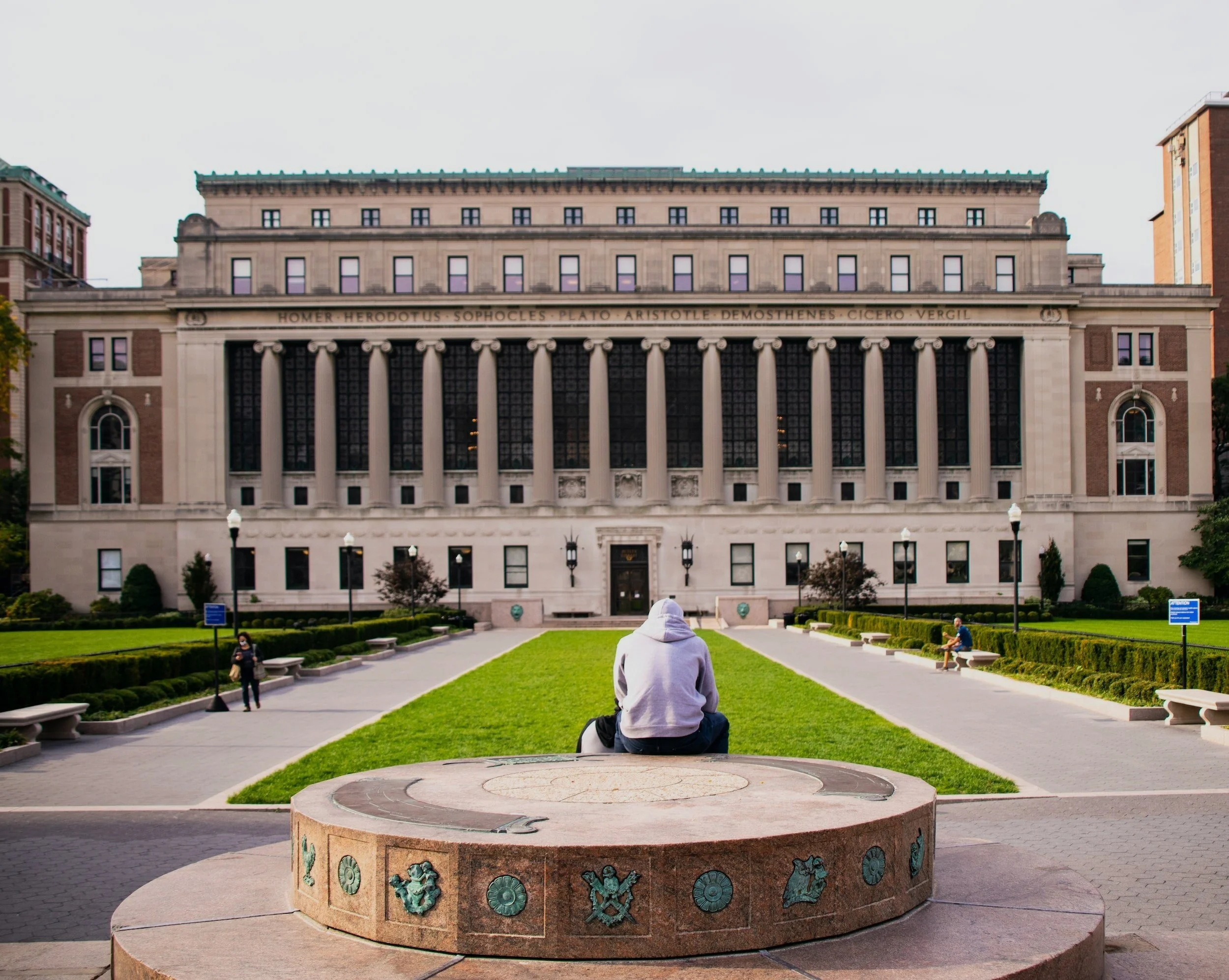
Whether you're starting a career in climate, hiring talent, or building on the latest research, New York's universities are the place to start.
Columbia University, New York University, Cornell Tech, Stony Brook University, and the City University of New York anchor the region's climate research and feed talent into the industries doing the work. Read on for a starter guide to the major programs and centers.
Columbia University
Columbia Climate School
The Columbia Climate School is a new school at Columbia University that is dedicated to addressing climate change. The school offers a variety of programs, including undergraduate and graduate degrees, as well as research and outreach initiatives.
Earth Institute
The Earth Institute is a research institute at Columbia University that focuses on the Earth and its environment and is now part of the broader Columbia Climate School. Its work includes climate change, sustainable development, and related environmental issues.
Lamont-Doherty Earth Observatory
Lamont-Doherty Earth Observatory is a research center at Columbia University that focuses on the Earth's natural systems. The observatory has programs focused on climate change, including the Center for Climate and Life, and provides research expertise and infrastructure relevant to climate science.
Center on Global Energy Policy
The Center on Global Energy Policy is a research center at Columbia University that focuses on energy and climate change. The center has a number of programs that focus on developing and implementing policies to address climate change.
Center for Sustainable Investment
The Columbia Center on Sustainable Investment is a research center at Columbia University that focuses on sustainable investment. The center has a number of programs that focus on developing and implementing sustainable investment strategies.

New York University
Center for Urban Science + Progress
CUSP is NYU Tandon's urban-informatics center and graduate school, treating New York as a living lab across transport, energy, air quality, and public health. It offers degrees, capstones, and internships, not a funded cohort, so it supplies talent, applied research, and city datasets rather than capital or space. Founders needing incubation route to NYU Tandon Future Labs and Urban Future Lab. It is particularly relevant to data-heavy urban and climate founders recruiting talent or partnering on research.
Urban Future Lab
Urban Future Lab at NYU Tandon is New York's longest-running climatetech incubator, home to ACRE, backing founders from pre-seed to Series A without taking equity. Companies get workspace, advisory across legal, accounting, and design, and introductions to investors, mentors, and corporate buyers, backed by NYSERDA, NYCEDC, and National Grid. Adjacent programs include the Carbon to Value carbontech initiative, the Offshore Wind Innovation Hub, an international landing pad, and the Urban Future Prize, which pairs non-dilutive cash with an ACRE spot. It is a strong option for early clean energy, grid, buildings, and mobility founders who want NYC market access and a clean cap table.
Sustainable Engineering Initiative
NYU Tandon's Sustainable Engineering Initiative develops engineering approaches to cut emissions and support adaptation, with connections to Urban Future Lab. It is a research and education initiative, not a founder program, so startups enter through UFL and ACRE. Its draw is the faculty, students, and lab resources it coordinates. It works well for early hardware and systems founders who want an academic partner beside a working incubator.
NYU Climate Action Plan
The NYU Climate Action Plan sets a goal of achieving carbon neutrality by 2040. The plan outlines a number of strategies for reducing the university's emissions, including investing in renewable energy, improving energy efficiency, and reducing waste.
NYU Office of Sustainability
The NYU Sustainability Office is responsible for implementing the NYU Climate Action Plan. The office works with students, faculty, and staff to develop and implement sustainability initiatives on campus.
NYU Green Grant
The NYU Green Grants program provides funding to student, faculty, administrator, and staff projects that promote sustainability. The program has funded a wide range of projects, including solar panel installations, energy efficiency upgrades, and composting programs.

Cornell
Urban Tech Hub
Cornell Tech's Urban Tech Hub is an applied research and ecosystem center for urban technology, not an accelerator, spanning research, teaching, and ties to city government. It runs a dual-master's urban tech track, sponsored research, convenings, and policy work with NYCEDC on how the city pilots technology. For founders it offers credibility, research partnership, and paths into city-agency pilots, not funding. It is geared toward urban and climate startups seeking a research ally and warmer public-sector introductions.
Runway Startup Postdoc Program
Runway at the Jacobs Technion-Cornell Institute turns technical PhDs into founders, part business school, part research institute, part incubator on Roosevelt Island. Fellows can start from an idea and receive salary, research budget, housing allowance, workspace, IP support, and mentorship from day one. The company issues a SAFE to the Institute, making this dilutive, with introductions to NYC investors and the Cornell and Technion networks. It is designed for recent technical PhDs building a company in New York with runway to de-risk the science.
PiTech
Cornell Tech's PiTech applies technical talent to social and environmental outcomes through an impact studio, PhD fellowships, visiting practitioners, and a Runway pathway for public-interest founders. That Runway track is the relevant door for climate founders building ventures with public benefit at the core. Otherwise PiTech is education and placement, not a funded accelerator. It is most relevant to technical PhDs and postdocs building public-interest ventures at the climate-society intersection.
Stony Brook University
Institute of Sustainability, Electrification and Energy
Stony Brook's Institute of Sustainability, Electrification and Energy, housed within the Advanced Energy Research and Technology Center, focuses on energy research, validation, and commercialization. For founders it connects to an on-site commercialization ecosystem with lab and test space via facility-use permits, business and technical resources, and access to Brookhaven National Lab, alongside CEBIP and NYSERDA proof-of-concept programs. It supplies research, space, and equipment rather than functioning as a standalone grant or equity program. Long Island and deep-tech energy hardware founders can use it when they need lab and validation infrastructure.
Energy Systems research
Energy-systems work in Stony Brook's College of Engineering spans batteries, grid, and advanced materials as academic research, not a founder program. Commercialization runs through AERTC and CEBIP for incubation and the Long Island High Technology Incubator for lab and office space. Founders tap the faculty and facilities here while getting structured support from those programs. It is useful for research-driven energy founders building on Stony Brook science with incubation nearby.

The City University of New York
Sustainable CUNY
A program of the Office of Sustainability and Energy Conservation that leads transformational change on CUNY campuses and in NYC through initiatives such as CleanTech Scholars, Smart DG Hub, and Solarize NYC.
Master of Sustainability in the Urban Environment
An interdisciplinary graduate program offered jointly by the Spitzer School of Architecture, the Grove School of Engineering, the City College Science Division, and the Colin Powell School for Civic and Global Leadership. It prepares students to devise new generations of buildings, urban infrastructure, and open spaces while considering rapid urbanization, climate change, resource limitations, and potential environmental degradation.
Sustainability in the Urban Environment Program
A program that accepts applications for students who begin the program each fall and spring. It offers courses on topics such as urban ecology, environmental policy and planning, green design and engineering, renewable energy systems, and urban resilience.
Environmental Sciences Initiative
CUNY's Advanced Science Research Center at City College runs environmental labs for chemical and isotopic measurement, coastal ecosystems, microbial ecology, and remote sensing, plus a rooftop observatory and shared core facilities. It serves researchers, not a startup cohort, offering instrumentation, measurement expertise, and collaboration. Teams needing sensing, characterization, or nanofabrication use its equipment while funding and incubating elsewhere. It is most relevant to science-first climate founders who need specialized environmental measurement.